 Welcome to the United Nations


The Financing for Sustainable Development Report 2026: Implementing the Sevilla Commitment finds that development progress is imperiled by global fragmentation and a financing squeeze facing developing countries. Instead of progress promised in 2015, the world is rapidly moving backward. The FSDR 2026 shows how the Sevilla Commitment can be operationalized to reverse the current trends in financing for development, even in these most difficult circumstances. The implementation of the Sevilla Commitment represents the best hope to achieve the SDGs.

Young people are a vital driving force in all societies, contributing energy, innovation and creativity to national development and to the achievement of the Goals and targets of the 2030 Agenda for Sustainable Development. Yet, many continue to face significant barriers that limit young people’s ability to realise their full potential and to participate meaningfully in society.
World Population Highlights 2026: Youth provides sound, comparable and timely data on global youth population trends, including changes in size and geographical distribution and key dimensions of youth well-being. The report identifies priority actions to reduce disparities, promote sustainable livelihoods…

Urbanization is reshaping the global landscape of human life. Since 1950, the share of the world’s population living in urban areas has surged, and it is projected to continue rising through 2050. This report presents the highlights of the 2025 Revision of the World Urbanization Prospects and offers a concise yet powerful overview of this transformation, combining global and regional trends with country-level insights spanning the period from 1950 to 2050. At the heart of this edition is the Degree of Urbanization, a harmonized, spatially based approach that enables meaningful international comparisons, alongside results based on national definitions. The dataset includes the latest…

As the United Nations marks its 80th anniversary in 2025, this report by the Department of Economic and Social Affairs (UN DESA) traces the evolution of sustainable development within the UN system. It highlights the organization’s role in shaping both the understanding and the practical application of sustainable development.

The UN DESA Annual Highlights report is a tool to communicate the contributions of the Department to the realization of internationally agreed development goals and shared social, economic, and environmental aspirations. It showcases the Department’s role in gauging trends, building capacities, and shaping solutions. UN DESA Highlights 2025 covers activities over the period of the 79th Session of the General Assembly (September 2024 – August 2025) and reflects the Department’s response to the set priorities and expressed needs of Member States. Seven (7) thematic chapters showcase how UN DESA put its expertise to the task of supporting Member State efforts to implement the 2030 Agenda…
This manual picks up where the previous manual in the series left off. The earlier manual, on the methodology of National Transfer Accounts (NTAs), shows how National Accounts data can be used to construct age profiles of economic production and consumption and to illustrate how resources flow from persons in age groups producing more than they consume to those in age groups producing less than they consume (United Nations, 2013).
The NTA project calls this system of age-based transfers the “generational economy”. Uncovering and elucidating the role of such transfers has been the project’s major contribution. NTA research has revealed how countries have evolved various means…
International Migration and Sustainable Development examines the linkages between international migration and the social, economic and environmental dimensions of sustainable development. It discusses how international migration is defined and measured, examines levels and trends in international migration at the global and regional level and by income group, explores the growing scope and impact of international migration and reviews its relevance for achieving internationally agreed sustainable development Goals and targets. The report also offers policy recommendations focusing on the social, economic and environmental causes and consequences of…
The UN DESA Annual Highlights report is a tool to communicate the contributions of the Department to the realization of internationally agreed development goals and shared social, economic, and environmental aspirations. It showcases the Department’s role in gauging trends, building capacities, and shaping solutions. UN DESA Highlights 2023–2024 covers activities over the period of the 78th Session of the General Assembly (September 2023 – August 2024) and reflects the Department’s response to the set priorities and expressed needs of Member States. Seven (7) thematic chapters showcase how UN DESA put its expertise to the task of supporting Member State efforts to implement the 2030…
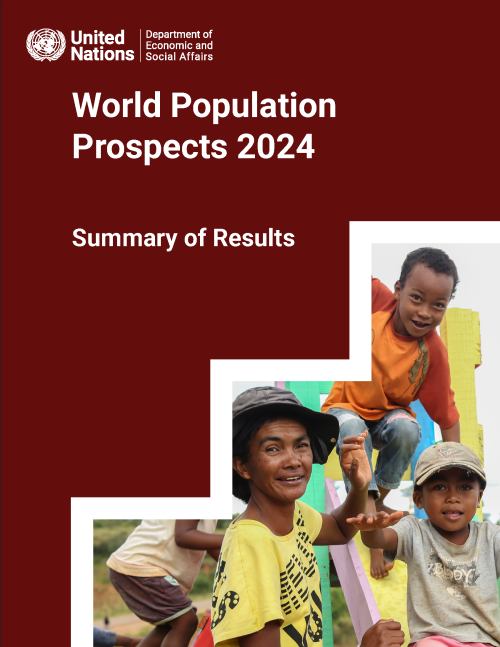
World Population Prospects 2024: Summary of Results adopts the analytical framework of the demographic transition—the historic shift towards longer lives and smaller families—approximated here by the timing at which populations peak in size, to explore differences in population trends that characterise countries and regions today and provide insight into their future trajectories. The report also offers policy recommendations to prepare countries for a population size, age structure and spatial distribution that may differ appreciably from that of their recent past.
World Population Prospects 2024 is the twenty-eighth edition of the official United Nations population…

This report, Thirty years after Cairo: Major trends, progress made and challenges ahead, gives a broad overview of global demographic trends since the International Conference on Population and Development, held in Cairo in 1994, and those foreseeable over the next 30 years. These include the continued yet slowing growth of the global population, its progressive ageing, and the increasing urbanization and scale of international migration.
The report highlights the similarities and gradual convergence of demographic trends across major groups of countries, as well as the diversity of demographic situations among certain…
The world is facing a sustainable development crisis. The 2024 Financing for Sustainable Development Report: Financing for Development at a Crossroads finds that financing challenges are at the heart of the crisis and imperil the SDGs and climate action. The window to rescue the SDGs and prevent a climate catastrophe is still open but closing rapidly.
Financing gaps for sustainable development are large and growing – the estimates by international organizations and others are coalescing around $4 trillion additional investment needed annually for developing countries. This represents a more than 50% increase over the pre-pandemic estimates. Meanwhile, the finance divide has not…