 Welcome to the United Nations


INTRODUCTION
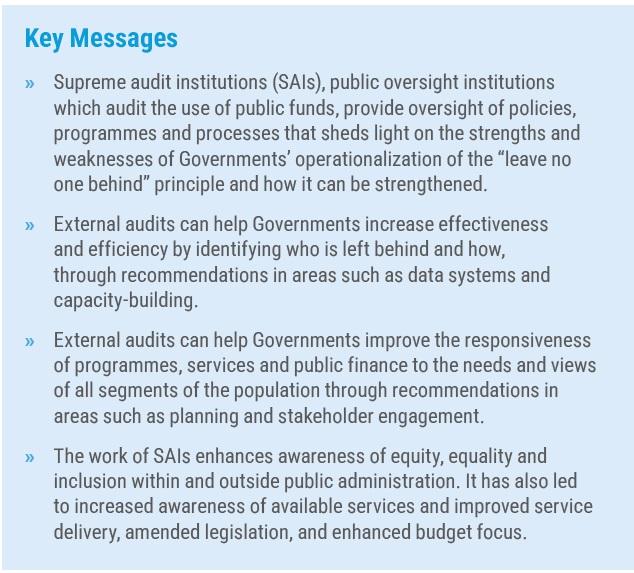
Progress towards the achievement of the Sustainable Development Goals (SDGs) is limited and uneven, with just 35 per cent of targets either on track or making moderate progress, nearly half moving too slowly and 18 per cent in decline. The realization of United Nations (UN) Member States’ pledge to both “leave no one behind” and to “endeavour to reach the further behind first” in implementing the Goals therefore remains distant. Yet notable achievements across regions and countries demonstrate that change is possible. The lead-up to the forthcoming Second World Summit for Social Development (4-6 November 2025) has provided a space for Governments to intensively review and engage in dialogue on policies and programmes towards accelerating action on social inclusion, poverty eradication, and decent work, including to give impetus to the implementation of the 2030 Agenda for Sustainable Development. In support of these aims, Governments can benefit from external audits that identify institutional constraints to the implementation of policies and programmes and that provide recommendations to enhance operational effectiveness and efficiency.
Supreme audit institutions (SAIs) are a vital resource that can be tapped by Governments to help strengthen their efforts to achieve sustainable development that leaves no one behind. They promote transparency and accountability in the use of public resources. As part of this work, their oversight of policies, programmes and processes sheds light on the strengths and weaknesses of Governments’ operationalization of the leave no one behind principle and how it can be enhanced. These insights are reflected in audit findings and recommendations. SAIs also support accountability for Governments’ commitments in those areas.
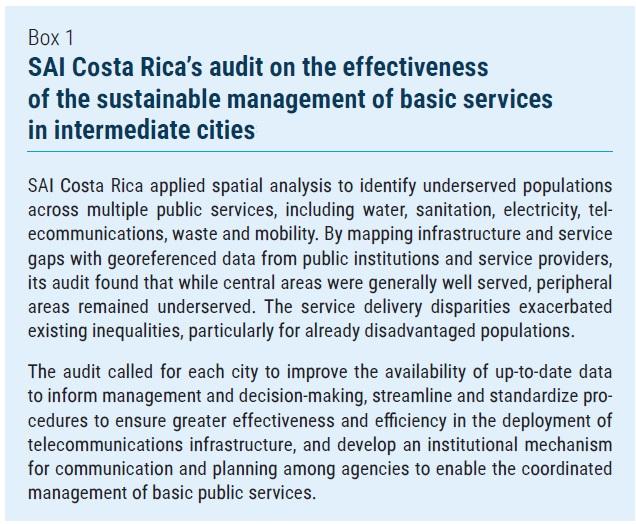
One way to view the operationalization of the leave no one behind principle in audits is through three overlapping approaches. First, some audits assess the reach of universal public services in order to identify who is left behind from them and why. They address, for instance, the inclusive-ness of water services through their coverage and quality, whether addiction treatment services are available to all, and access to social protection. A summary of an audit with this approach is presented in Box 1. Second, there are audits that address challenges distinctly affecting disadvantaged individuals and groups, such as women, persons with dis-abilities, people living in poverty, children, youth, older persons, Indigenous Peoples, racial minorities and migrants and refugees. They examine, for instance, efforts to prevent and combat violence against women and the provision of quality education to children with disabilities. Third, SAIs can mainstream an equity, equality and inclusion perspective in their audits across issues. That is, they can include consideration of how policies, programmes and processes—in areas from poverty to agriculture and transportation—affect different groups of people differently, and how they can be improved for more equitable and inclusive outcomes.
Among the actors in Governments’ institutional systems, SAIs are well positioned to assess issues related to the leave no one behind principle. They have a distinctly cross-cutting mandate, and their external vantage point and, in many cases, experience with whole-of-government audits, facilitate their scrutiny of government operations. SAIs’ independent role may also be advantageous in helping audited entities navigate sensitive aspects of equity, equality and inclusion, such as ensuring respect for cultural values and gender responsiveness in public ser-vices, and address biases that risk hindering progress. At the same time, a leave no one behind lens can enhance the quality of audits by enabling the identification, examination and highlighting of whom government services benefit and bypass. Equity, equality and inclusion considerations have been increasingly integrated into the work of SAIs since 2016, though there is still considerable scope for their greater application. Some of the challenges experienced by SAIs working in this area include staff capacity, data limitations, and concern that the issues may be viewed as belonging to the political sphere.
This policy brief draws attention to the value of external audits to Governments’ efforts to leave no one behind. It highlights some impacts of audit reports on equity, equality and inclusion. It then presents observations and examples from a review of audit report recommendations, which can inform and guide Governments in strengthening their work in this area.
IMPACTS OF EXTERNAL AUDITS ON EQUITY, EQUALITY AND INCLUSION
Audits can have a range of impacts on equity, equality and inclusion. They raise awareness of issues and perspec-tives related to the leave no one behind principle and build knowledge and understanding of issues that are often overlooked, undervalued and poorly understood. In some cases, audit reports garner media attention. Such audits also add practical value to the work of public administration, including its efforts to implement the SDGs; they can increase effectiveness and efficiency by identifying who is left behind and how, and help to ensure that programmes, services and public finance are responsive to the needs and views of all segments of the population.
SAIs’ impacts in this area have been achieved through various channels, only some of which are mentioned here. Audits have led to the enhanced implementation of government commitments to apply analytical processes that sup-port the leave no one behind principle. The Government of Canada utilizes gender-based analysis plus (GBA Plus) to assess inequalities and determine how gender and other social identities can impact access to programmes and ser-vices. A SAI Canada audit report led to requirements, in 2016, that GBA Plus be applied to Memoranda to Cabinet and Treasury Board submissions, which are presented to Cabi-net for approval.
Audits have led to measures aimed at raising awareness of available services among the public. For instance, a SAI USA audit report led to two government agencies coordinating on taking steps to promote awareness of centres and other resources that help families find appropriate care for children with disabilities. An audit report by SAI Uganda on intimate partner violence led to extensive government-sponsored media campaigns, the creation of free hotlines, and other outreach efforts to encourage the reporting of such violence.
Audits have also spurred the development of departmental policies and action plans. Following SAI Costa Rica’s audit of the Government’s preparedness to implement the SDGs, which had a focus on SDG 5, several entities took steps towards approving gender policies. SAI Lithuania’s audit on the social inclusion of persons with disabilities led to an action plan of the Ministry of Transport and Communications to increase the accessibility of transportation modes and infrastructure. The same audit report had other key impacts, including the amendment of legislation to require municipalities to include accessibility as a criterion for the purchase of new vehicles or transport services, and improved employment services that led to more people with disabilities in employment. Among other examples of improved service delivery, SAI Kenya’s report on the provision of services to persons with disabilities led to the development of a digital system for disability registration and an expansion of the number of assessment centres. In Angola, the SAI’s SDG-related audit recommendations led to annual focus of the General State Budget on the budget dedicated to gender-related issues.
In some cases, an SAI’s impact is effected through a sustained monitoring role. For example, in its 2025 follow-up audit on Child and Family Services in Nunavut, SAI Canada found a persistent lack of progress in improving services to children and families and determined that it would perform regular status updates on actions to address past audit findings and recommendations.
CHALLENGES AND OPPORTUNITIES COMMONLY IDENTIFIED BY SUPREME AUDIT INSTITUTIONS TO ENHANCE EFFORTS TOWARDS EQUITY, EQUALITY AND INCLUSION
Many audit reports find challenges related to planning, implementation, data management and oversight, as well as areas such as capacity and stakeholder engagement. Broadly, they reveal insufficient responsiveness to the needs and views of marginalized individuals and groups. For instance, SAI Greece’s audit report on the social reintegration of prisoners found that “The actual reintegration needs of detainees are not taken into account when selecting specific reintegration actions. The procedure of informing the detainees about the programmes implemented in the Detention Centers does not ensure their equal access to programmes in which they could join.” Audit findings and recommendations highlight such gaps and bottlenecks and identify ways to address them, contributing to more effective and responsive service delivery.

Opportunities to enhance planning and processes for public services
Some audit reports have found opportunities to improve planning through the development of strategies to address gaps in services, such as water, housing and connectivity. SAI USA recommended, in an audit report on drinking water, the development of a strategic plan that meets a legal requirement to provide “targeted outreach, education, technical assistance, and risk communication to populations affected by the concentration of lead in public water systems, and that is fully consistent with leading practices for strategic plans.”12 Recommendations have also been made in some reports to improve service uptake and the tailoring of plans and programmes to needs. For instance, SAI New Zealand, in its report on meeting youth mental health needs, recommended prioritizing work to understand the prevalence of mental health conditions in the population.
Audit reports often contain recommendations to develop or enhance institutional mechanisms, guidelines and procedures to improve internal government processes. SAI Kenya, for instance, in its audit report on the management of a cash transfer programme for older persons, recommended improving notifications to beneficiaries of payment dates and payment delays. Some reports have recommended the adoption of quality service standards as well as the development or enhancement of information systems to manage seamless and responsive service. SAI Lithuania recommended the development of an integrated system for assessing individual needs and providing appropriate assistance in its audit report on the social integration of persons with disabilities. Audit report recommendations have also addressed standardization, streamlining and timeliness as well as including equity and inclusion in performance assessments.
Opportunities to enhance data management and oversight of public services
Many audit reports have identified the need to strengthen data systems, including through enhanced data collection and disaggregation and system interoperability, such as for registration and beneficiary tracking. Reports have proposed that Governments aim to ensure that data are validated, sufficient to assess effectiveness, protected, as well as intersectional, reflecting the intersection of social identities (e.g. sex, age and race), and culturally appropriate. Some have recommended ways to better utilize data, including to determine needs, assess tailored programmes and policies and identify gaps. For instance, the European Court of Auditors, in its audit report on supporting persons with disabilities, recommended the gathering of “more comparable data on the situation of persons with disabilities in terms of coverage, granularity and frequency.” This was to enable measurement of the impact and effectiveness of the EU’s policy framework for persons with disabilities. The importance of the timely and public reporting of data and sharing data with non-governmental stakeholders has also been reflected in reports.
Some reports have also identified opportunities to establish oversight mechanisms and improve the oversight of a range of areas such as services, quotas, accessibility standards, benefit transfer systems, and compliance with guidelines and human rights. SAI India has recommended undertaking social audits in several audit reports, including to determine the extent to which initiatives benefited target groups.
Opportunities to enhance engagement with non-governmental stakeholders and the capacity of public servants
Numerous audit reports have called for consultation, dialogue and collaboration with non-governmental stakeholders in programme design, planning, implementation and evaluation. SAI Canada, in its report on the First Nations and Inuit Policing Programme, recommended that Public Safety Canada work with First Nations and Inuit communities in the development and implementation of a renewed approach to the programme that includes working in partnership with programme recipients consistently and meaningfully. SAIs’ recommendations have also called for engagement on legislative reform. SAI Fiji, in its report on the coordination of actions on eliminating violence against women, recommended strengthened dialogue with civil society organizations (CSOs) in this regard, and that efforts to review compliance with the Convention on the Elimination of All Forms of Discrimination Against Women be coordinated with them.
Some reports have highlighted opportunities to build the capacity of public servants. Recommendations have addressed assessing staffing needs and ensuring adequate staffing for the delivery of services and programmes, particularly in underserved or vulnerable areas such as rural areas and Indigenous communities. They have also cited the need for training and upskilling, notably in specialized areas. SAI Albania, in its audit report on the protection of domestic violence victims, recommended organizing specialized training for health and social workers and legal professionals on gender-based violence and accelerating training for police officers on risk assessment and case handling.
CONCLUSION
Supreme audit institutions provide important and growing contributions to Governments’ efforts to leave no one behind. Through examining the degree to which Governments know and are serving people, external audits can foster inclusive use of public resources. Recommendations commonly found in audit reports span institutional dimensions—with many addressing elements of data management, oversight, planning, processes, stakeholder engagement, and capacity-building—and can contribute to better and fairer development outcomes. The work of SAIs also supports enhanced accountability for Governments’ varied commitments to equity, equality and inclusion, including to human rights, and can foster trust in government among marginalized groups.
As external bodies, SAIs are well-suited to scrutinize often cross-cutting issues related to the leave no one behind principle. Though integration of the principle into audit practice is far from universal or uniform, consideration of equity, equality and inclusion is becoming more prominent. There is increasing scope for Governments to leverage the insights and recommendations contained in audit reports to strengthen work in this area, thereby reinvigorating progress towards social development and the 2030 Agenda.